
The Art of Adjustments in Yoga: Guiding Students Toward Safe Depth and Embodied Awareness
One of the most subtle yet transformative skills in yoga teaching is the art of adjustments. Whether verbal, physical, or purely energetic, adjustments help students find greater alignment, ease, and depth in their asana practice. When done with awareness, sensitivity, and consent, adjustments can illuminate entirely new pathways in the body—pathways that students may never have discovered on their own.
Why Adjustments Matter
The purpose of an adjustment is not to “fix” a pose, but to guide the practitioner toward a safer and more refined expression of the asana. A well-delivered adjustment can help a student
understand the intended direction of the posture,
activate or relax the right muscle groups,
feel supported enough to explore deeper layers of the pose, and
expand their sense of what is possible.
During our 200-hour Hatha Vinyasa Yoga Teacher Training, we explore this skill extensively in our Asana Clinic classes. Here, trainees learn not only how to get a student into an asana safely, but also how to maintain the posture, adjust with clarity, and guide them out of it gracefully—all of which form the foundation of responsible, mindful teaching.
The Importance of Consent
Adjustments can be powerful, intimate moments of learning. This is why consent is non-negotiable. Even the most experienced teacher cannot know what a body is holding on any given day—emotionally, physically, or energetically. Asking for consent creates trust, empowerment, and choice. It ensures that students feel respected, seen, and comfortable enough to surrender into the moment if they wish to.
Types of Adjustments
Adjustments come in many forms, and each style has its own intelligence:
1. Verbal Adjustments
Sometimes the lightest touch is a well-timed cue.A simple instruction—“lengthen your spine,” “soften the jaw,” “press through the inner feet”—can shift a student’s entire experience of a posture. Verbal cues also help develop the student’s bodily awareness, so they learn to adjust themselves intentionally.
2. Physical Adjustments
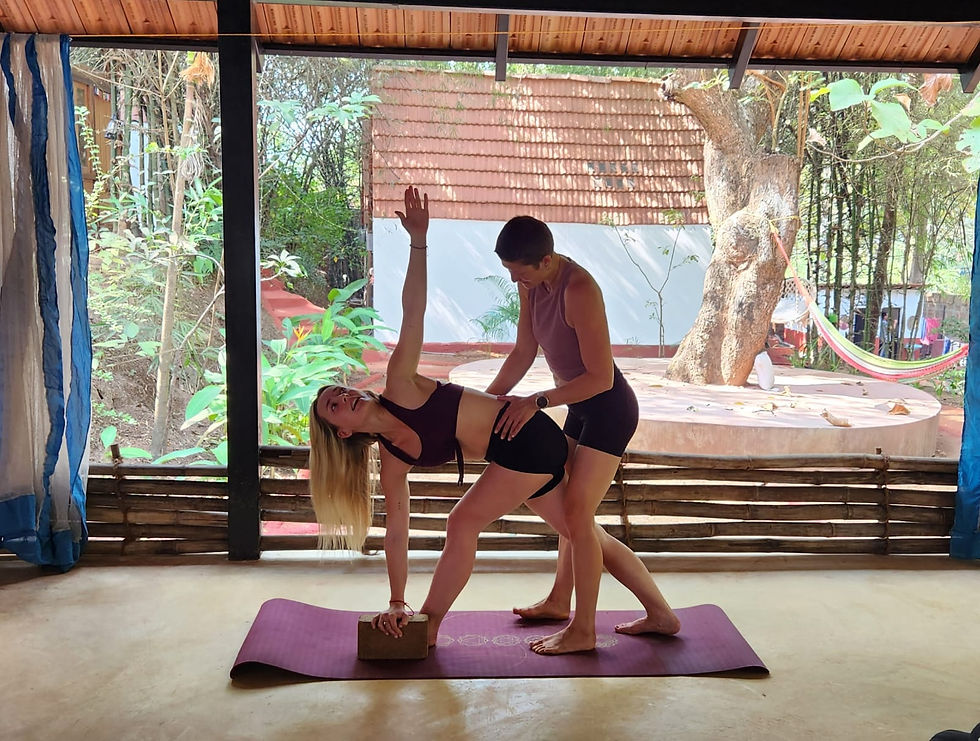
Physical adjustments can be supportive or directional.A teacher might help stabilize the pelvis, root the feet, or assist a student in finding more space through traction or pressure. In our teacher trainings and yoga retreats, students often remark how a gentle, confident physical adjustment can help them experience an asana more deeply than they ever could alone, safely expanding the boundaries of their comfort zone. One or even more people together can help to adjust a practitioner, with or without props (blocks, belts) or even with the help of the wall.
3. Energetic Adjustments
These subtle adjustments require presence, intuition, and attunement.Sometimes the teacher simply mirrors the student’s breath or lightly engages the space around them to guide their attention inward. This kind of adjustment can be transformative for students who need grounding, reassurance, or emotional support.
4. Holding Space
Occasionally, the most powerful adjustment is no adjustment at all.Standing close, observing with compassion, and giving a student the space to explore without interference can help them develop autonomy and confidence in their practice.

Pushing Without Forcing
A skilled teacher understands the delicate balance between expansion and protection.Too much pressure—or the wrong kind—can injure a student. Yet gentle encouragement, applied intelligently, can show them a new edge, a new possibility, a new understanding of their strength or flexibility.
On our yoga holidays and retreats, students often appreciate how our teachers support them to explore these edges with safety and encouragement. Many discover aspects of their practice they didn’t know they were capable of.
The Evolution of the Teacher: Adjustments Beyond Technique
As teachers deepen their studies, the art of adjustment naturally evolves.In our 300-hour Teacher Training, we explore a more holistic approach that includes working with advanced asanas, refined alignment, energetic principles, and the emotional landscape of practice. Trainees learn how to read bodies with greater nuance and how to offer adjustments that honor the whole person—not just the shape of the pose.
This level of teaching invites a deeper presence, and the adjustments become not just technical corrections but expressions of connection, intuition, and wisdom.
In the End, Adjustments Are About Connection
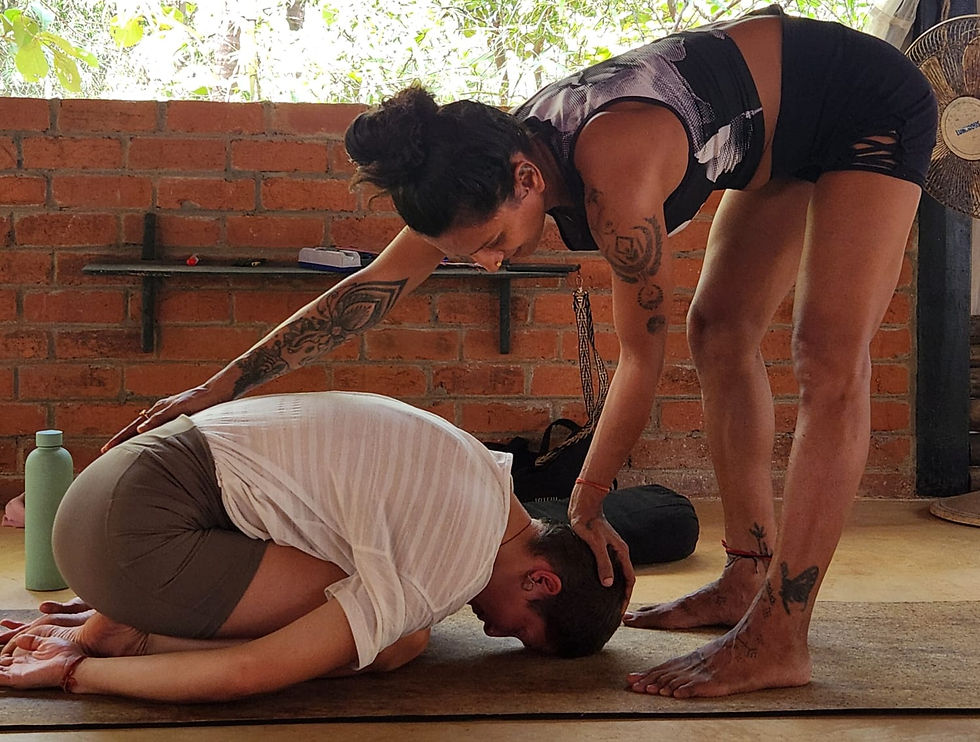
At their core, adjustments are a dialogue—a silent, respectful communication between teacher and student. When offered with compassion and clarity, they help students feel safe enough to soften, strong enough to expand, and supported enough to explore parts of themselves they may not have met before.
Whether in our teacher trainings, classes, or retreats, we aim to share this beautiful art with sincerity and care, helping every practitioner find their way into the fullest expression of their practice.
What We Offer 🎉
Explore our range of authentic programs.
Yoga holiday retreat
Conscious living yoga retreat
Yoga teacher certificate course
100-hour Yin yoga teacher training
300-hour advanced Yoga teacher training
all designed to support your healing and transformation.
We invite you to explore our offerings and join us in Goa to recharge, rethink, and revitalize your body, mind, and spirit.


Comments